Is Irish a Dead Language?

Recently, I mentioned to someone near and dear to me that I was attempting to learn some Irish, but I felt the pronunciation and words keep changing. They said that was because Irish was a dead language. Is it? What exactly is a dead language?
Irish language is not dead. Granted, it came close. As I’ve mentioned before, English rule pretty much demanded English as the only language. Immigrants, wanting to fit in, stopped speaking Irish. The language persisted in more isolated regions and often as an act of defiance.

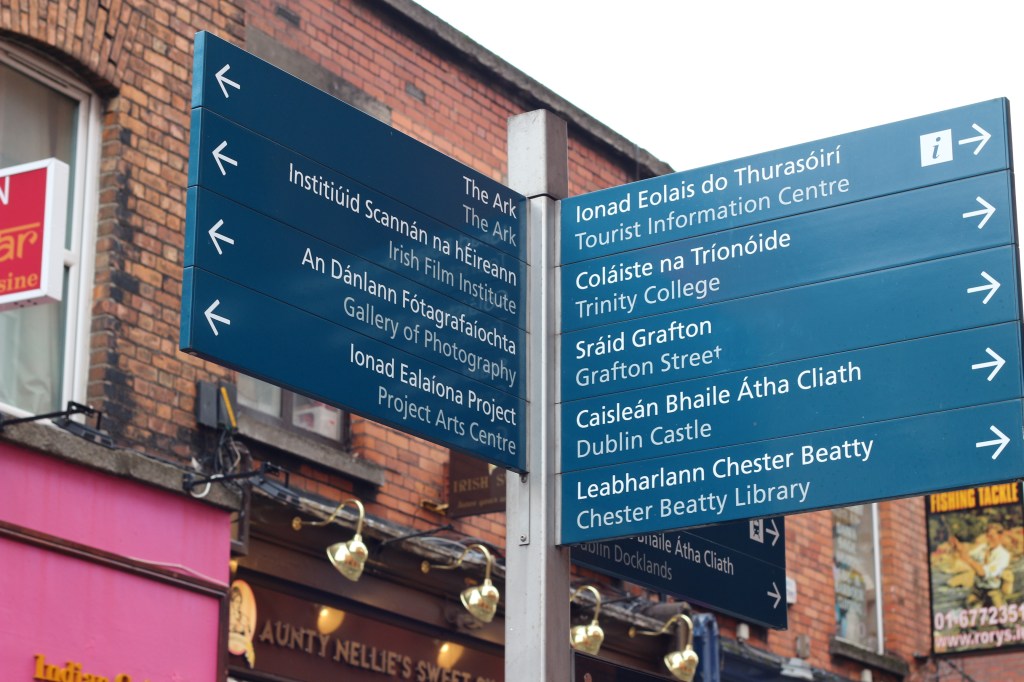
One article I read pointed out that people have a difficult time with Irish names because they don’t understand that Irish exists as a language and try to put English rules to said names and it just doesn’t work. Once you realize that the rules are different, then it’s easier to understand how names are pronounced. An example is BH will make a W or a V sound. FH is silent. Like any language, once you learn the rules, alphabet, and pronunciation…well, I’m not going to say it’s easy, but it helps. Helpful site here, if interested: https://www3.smo.uhi.ac.uk/gaeilge/donncha/focal/features/irishsp.html#:~:text=Irish%20does%20the%20same%20sort,bh%20(broad)%20%3D%20w

What makes a language dead? According to Global Language Services, “a dead language is (usually) defined as a language that some people still use, even if there are no native speakers left.” Latin is a prime example. It’s taught and used for educational purposes, but no one speaks it as their primary language. https://www.globallanguageservices.co.uk/difference-extinct-language-dead-language/

 Old English is another example. It was spoken about 500 to 1100 CE. Beowulf is the oldest poem existing in Old English. Here are a few lines:

Hwæt. We Gardena in geardagum,

þeodcyninga, þrym gefrunon,

hu ða æþelingas ellen fremedon.

Oft Scyld Scefing sceaþena þreatum,

monegum mægþum, meodosetla ofteah,

egsode eorlas.

I had an English professor who spoke Old English and often read to us in that language. Though interesting to listen to, no one goes around speaking it anymore. And since there are no living people who speak Latin or Old English, we don’t even know if the pronunciation is correct.

Manx is an interesting language. It’s from the Isle of Man and was once dead, but the community revived it; it’s being taught on the Isle and is not longer a dead language; nor is it on its way to an extinct language.

I live close to a Ute reservation and sadly, many of the younger generation (at least here) don’t know the language. Many Native American languages have died.

Back to Irish. It is not dead. But, according to some sources, it is an endangered language. Approximately two million people in Ireland (including Northern Ireland) speak Irish—as a second language.  In 1922 the Free State was established (Republic of Ireland). They declared Irish the national language and a revival of all things Irish became popular. It is taught in schools, and in Connacht at least, I heard many people speaking it as their native tongue. The Government will require 20% of new public service employees to speak Irish by 2030. One of my favorite sites has a great little article on this: https://www.irishcentral.com/opinion/irish-language-legacy-cultural-wellbeing

 The younger generation is also involved by creating YouTube, TikTok, and Instagram posts to highlight and arrange meetings in the Irish language.

 Here are some wonderful songs in Irish you should check out:

https://www.irishcentral.com/culture/entertainment/avicii-wake-me-up-irish?fbclid=IwAR202gUBDmhs62lTfDO8-67s1NxyJ6PDRXAjpZGziaW6OrgJsWgCoB4umaI

You can give Irish a try on Duolingo and Mango (and probably other sites offering language learning). https://www.bitesize.irish/ is a great place for beginners also. This article highlights resources too: https://letslearnirish.com/articles/12-best-free-irish-resources/. Rosetta stone even has an Irish course. Some courses are free and some are not.

On one of the YouTube songs a comment was along the lines of, ‘I speak many languages and Irish is the most beautiful.’
My great grand mothers both spoke Irish. I wish I’d met them and learned a few things from them. Maybe learning a bit now will help me to better connect to them—and help keep the Irish language from dying out altogether.

What do you think? Should the Irish try to continue to revive their language? Is it a lost cause?
Are you speaking Irish?

Can you understand any of this?

A slew of Hooligans and their buddies were at the boycott. It was a real donnybrook! They smashed whisky bottles to smithereens and shouted phony slogans. They wore matching trousers and brogues. There were slobs galore hanging around who really dug what was going on and shouting, ‘shut your gob!’ to the crowd. It was a bunch of malarkey and no good shenanigans!

Though some words might be outdated or unfamiliar, you’ve probably heard most of these Irish words which made their way into the English language. As a living language, English takes words from all over the world and makes them its own. Irish is no exception and perhaps should be expected as so many Irish have emigrated to England, the United States, Canada, and Australia.

I love this quote by James D. Nicoll: “The problem with defending the purity of the English language is that English is about as pure as a cribhouse whore. We don’t just borrow words; on occasion, English has pursued other languages down alleyways to beat them unconscious and rifle their pockets for new vocabulary.” (I even have this quote on a T-shirt. English nerd alert, I know.) But aren’t words and their history fascinating?

Here are the words I used in my example that have Irish roots:

  1. Hooligan: This one surprised me. It actually comes from a surname, Houlihan (O hUallachain). They were apparently notorious for being a raucous bunch. The name became a sort of slur on the Irish, as ‘all Irish are unruly drunkards/hooligans’. Now it refers to someone up to no good in a mischief sort of way. Here’s a fun article for more information if you’re interested: https://qz.com/1306921/world-cup-2018-hooligans-is-an-ethnic-slur-in-history
  2. Donnybrook: This is a name of a district in Dublin. (Irish-Domhnach Broc) It has come to mean a free for all fight. That’s due to a fair that was held in Donnybrook every year from about 1204 to 1866. Must have been some fair! You can read more here: https://iomst.ie/a-brief-history-of-donnybrook-fair/#:~:text=This%20was%20the%20message%20to,fair%20was%20closed%20for%20good.
  3. Slew: According to the Merriam-Webster dictionary, Slew may be from slua/sluag meaning army/host/throng. It was used as part of a war-cry. Here’s a fun little read: https://mashedradish.com/2016/03/17/four-leaf-etymologies-slew/
  4. Slogan: A call/cry.This goes hand in hand with slew. The war-cry was, ‘sluag gairm’, or a call to arms. The Scottish also used this term.
  5. Galore: Back to the Merriam-Webster dictionary; Irish from go leor. It meant ‘enough’. We tend to use it as more than enough. “There were pies galore at the Donnybrook fair.”
  6. Boycott: Another surprise. Boycott is a last name. Charles Cunningham Boycott was an English land agent in county Mayo. He, and others like him, evicted Irish tenants in heartless and cruel manners as well as overcharging rents. This led to a land war all over Ireland in the 1880s. (And led to mass emigration once again, the Famine being the first wave.) The town shunned him in every way they could; they stopped work, refused to sell to him, etc. He wrote to a London paper and troops were called in. Basically, all hell broke loose. The idea of shunning- or Boycotting – caught on and gave the poor of Ireland some power. It became a popular way to fight the British. Interesting article here for more: https://www.irishcentral.com/roots/history/irish-invented-boycott
  7. Smithereens: Pretty straight forwardsmiodar to smidirin to smiddereens to smithereens.Means small fragments.
  8. Buddy: I stumbled into a hornet’s nest on this one. Some believe that much of our slang came from the streets of NYC with all the Irish and Irish gangs in the late 1880s to early 1900s. This is one of those words. Bodach, which translates to ‘strong, lusty youth’. Others disagree and would contend that it’s all malarkey. Fascinating article here: https://www.irishcentral.com/roots/history/irish-words-litter-new-york-slang
  9. Slob: from Vocabulary.com; Irish, Slab, which means ‘mud’. The expression slob comes from ‘slob of a man’. Meaning someone who worked in muddy land or bogs. https://www.vocabulary.com/dictionary/slob
  10. Whisky: ahhh, the water of life. Literally. Uisce means water. Beatha means of life. Usquebaugh. Interesting sideline; Whiskey is Irish and United States. Whisky is Scottish/Canadian. (It has to do with where the grain is distilled, but it was getting too technical for me.)
  11. Brogues: are shoes with small holes in them, originally meant to allow water and mud to ooze out, keeping one’s feet sorta dry. Now, they’re classy shoes. From Merriam-Webster: comes from the Irish word brog. Which means shoe. Probably comes from Old Norse (Vikings invasions). Brogue as an accent comes from a different word, barrog.

12. Dig: (slang) An dtuigeann tu? Do you get it? Dig it?

13. Gob: etymonline.com/gob says, ‘1540s Irish for mouth. Related to English gobbet. Related to goblet.’ I wonder if the British gobsmacked is also related?

14. Phony: Love this one! From Dictionary.com: “…likely comes from an old con known as the fawney rig. Fawney is…Irish for ‘finger ring,’ and rig is an old term for ‘trick’ or ‘swindle’. Check it out: https://www.dictionary.com/browse/phony#:~:text=While%20the%20exact%20origins%20of,trick%E2%80%9D%20or%20%E2%80%9Cswindle.%E2%80%9D

15. Trousers: The Irish were wearing trousers long before it became popular among men (and women). Trius to trouzes to trousers.

16. Shenanigans: What surprised me the most about this word is a disagreement of its origin. It could come from the Irish sionnachuighim which translates to “I play the fox”. There’s quite a discussion on reddit too—from defending Irish to saying it’s a Spanish word, (Chanada) to a German word (Schenigelei). Shenanigans is a fairly recent word that appeared about 1855 in California. Here is a short and sweet article for you to decide where you think it originated: https://www.worldwidewords.org/weirdwords/ww-she1.htm

17.  Malarkey: Definitely Irish, right? Well…the Oxford dictionary says, ‘specific origin is unknown’. It only came into use in the 1920s. However, the Visual Thesaurus states that it was made popular by Thomas A. Dorgan, a cartoonist of Irish descent. It certainly sounds Irish. Check it out here: https://www.npr.org/sections/thetwo-way/2012/10/12/162791655/whats-all-this-malarkey-about-malarkey#:~:text=According%20to%20Oxford%20Dictionaries%2C%20malarkey,word%20hasn’t%20been%20established.

One article I read pointed out (and rightly so) that compared to other languages, there aren’t a lot of Irish words in the English language. Speaking Irish, in Ireland, was looked down upon by the English. If you wanted to survive in the English controlled Ireland, one had to learn English. The Irish were made to feel shame in speaking their language. As the Irish immigrated, they wanted to fit in their new country, so they lost the Irish.

In Ireland, it became a secret language. Since Ireland reclaimed most of their country in 1922 they’ve worked to bring their language back. Roughly one million people speak Irish worldwide. It’s mostly a second language in Ireland, English being the first. The Connaught area has the most Irish speakers. Everyone on Inis Mor spoke Irish; it was really nice to listen to it. I found many speaking Irish in the Galway area. At LaGuardia I asked the man at the counter of Aer Lingus, who was from Ireland, if he spoke Irish. He appeared somewhat insulted and informed me he was from Northern Ireland and of course he didn’t speak Irish.

Were you familiar with any of the words on my list? What did you think about Shenanigans and Malarkey—Irish or not? Let me know if you found this interesting or helpful.

Slan for now.