

From toe-tapping tunes to ancient battles, Celtic peoples have used instruments to inspire, intimidate, remember culture, and enjoy some craic (a good time). Music has a magical way of transporting you to another time or place. It evokes emotions and memories. I’m not particularly musically inclined, but Scottish bagpipes stir my soul; Irish music speaks to me. Like many Irish Americans, it’s a reminder of ‘the old country’ that our great/grands spoke about. That longing for home that never quite went away.
Here are some instruments you might find as interesting as I did.
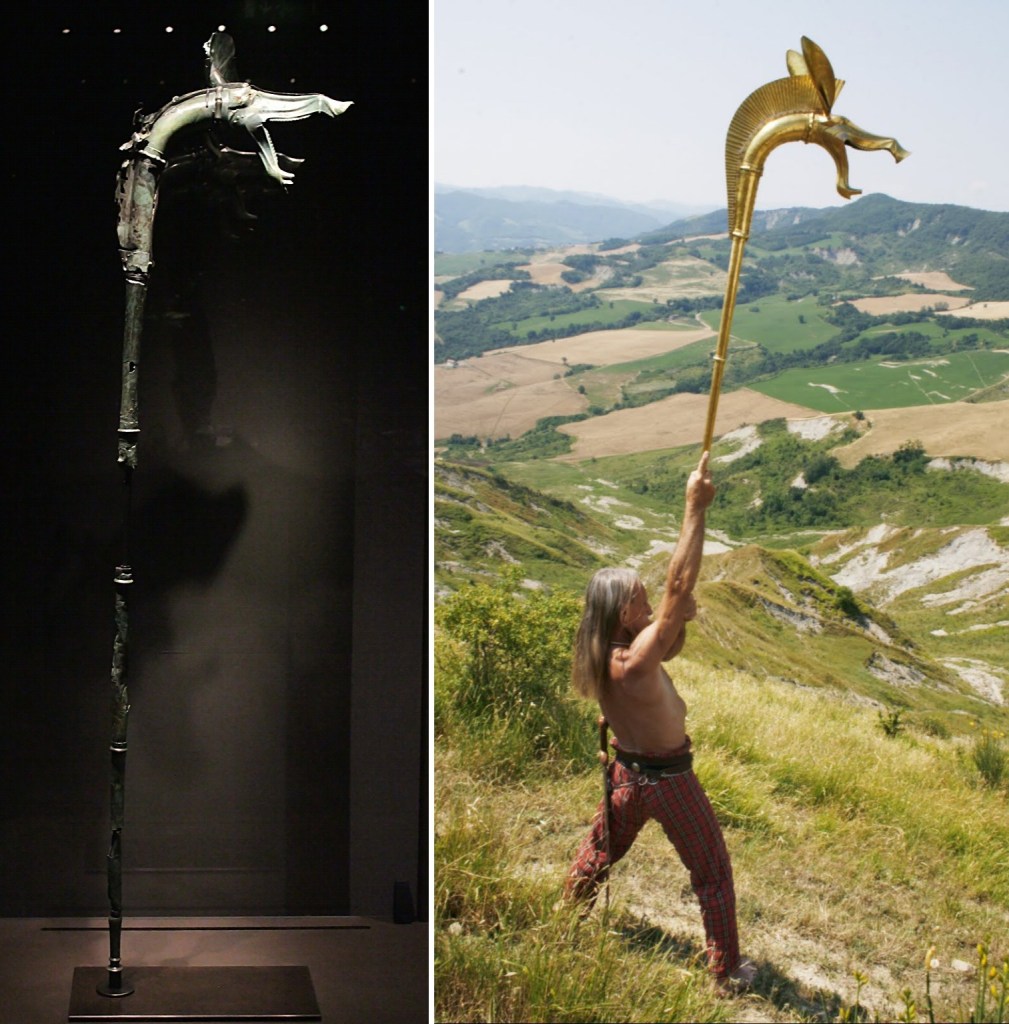
- Carnyx – As ancient as it gets! The carnyx is one of the earliest know musical instruments. It’s about 3000 years old and was use during the bronze age. It was a trumpet-based instrument about 12’ long. It had a thin bronze tube which was bent at right angles at both ends. The lower end had a mouthpiece and the top was decorated as a boar’s head or sometimes a serpent. A ‘tongue’ flapped in the creatures’ mouth making a haunting sound that carried over long distances. It was used in both warfare to intimidate enemies and also in ceremonies. Imagine an eerie melody rising from the mists, like wraiths, just before a battle. Especially if you’ve never heard it before—add to that the reputation of the fierceness of the Celts you’re about to fight. Then the drums start. Movies should have the carnyx. Remains of five carnyx have been found, but no complete ones. What’s amazing, but shouldn’t be so surprising, is that you can buy one on Amazon! Check out this video of one being played; you’ve never heard anything quite like it. https://www.youtube.com/watch?v=lVFGT2NX-YQ (Image from across the internet on dozens of sites in as many languages.)

2. Uilleann pipes (E-linn or IL-yen). Scottish pipes are popular world-wide with that either you love them or hate them sentiment. They are popular at parades, funerals, and special occasions. Did you know there was an Irish bagpipe too? Uilleann means ‘pipes of the elbow’. They are played using the arm/elbow, not the mouth. It has a sweeter and quieter sound than other bagpipes, like the Great Irish war-pipes or the Great Highland bagpipes. Surprisingly, bagpipes were brought to Scottland and Ireland by the Romans. Popular in the 1300s, both the Scotts and the Irish used them in battles against the English. The British banned all pipes in 1366 to discourage them as a war instrument. By the 1700s pipes were used by the upper class for enjoyment and ceremonies. The Irish pipe can be played sitting or standing. As they faded from popularity, the pipes were sold to the poorer classes, who added them to folk music. As Irishness declined in the 1800s, the pipes fell out of favor (except for the Irish). Clubs were created in the early 1900s to encourage Irish music, especially the pipes. Eamonn Ceannt led the Dublin Pipers Club to help establish them forever in traditional Irish music. It is said that it takes 7 years to learn, 7 years to play, and 7 years to master. Here are 2 links I hope you’ll take a look at: Jerry O’Sullivan explains the pipes: https://www.youtube.com/watch?v=olA-LAG0aRc&t=52s and listen to them here:

3. The Bodhran. I thought the bodhran drum was as ancient as the carnyx. Nope. It is a simple frame drum with a crossbar to brace the sides. Originally used as (perhaps) a winnowing tool, or for dying wool. Or as a Shamanic drum. The history is unclear. It was used in battles in the 1800s. It does have ancient use on 26 December, with the tradition of the Wren boys. (See my Christmas post for more on that.) In fact, the older generation felt that the only day to take out the bodhran was 26 Dec., any other time was crazy. It actually didn’t gain popularity until the 1960s with the great folk music revival! It has been labeled a poor man’s tambourine. (Sometimes the Wren boys put coins on the drum to make more noise.) It was first played with fingers rather than a tipper or beater. Detailed information here: https://blog.mcneelamusic.com/bodhran-history-evolution/
Watch here: https://www.youtube.com/watch?v=dMI4X8OOMOg
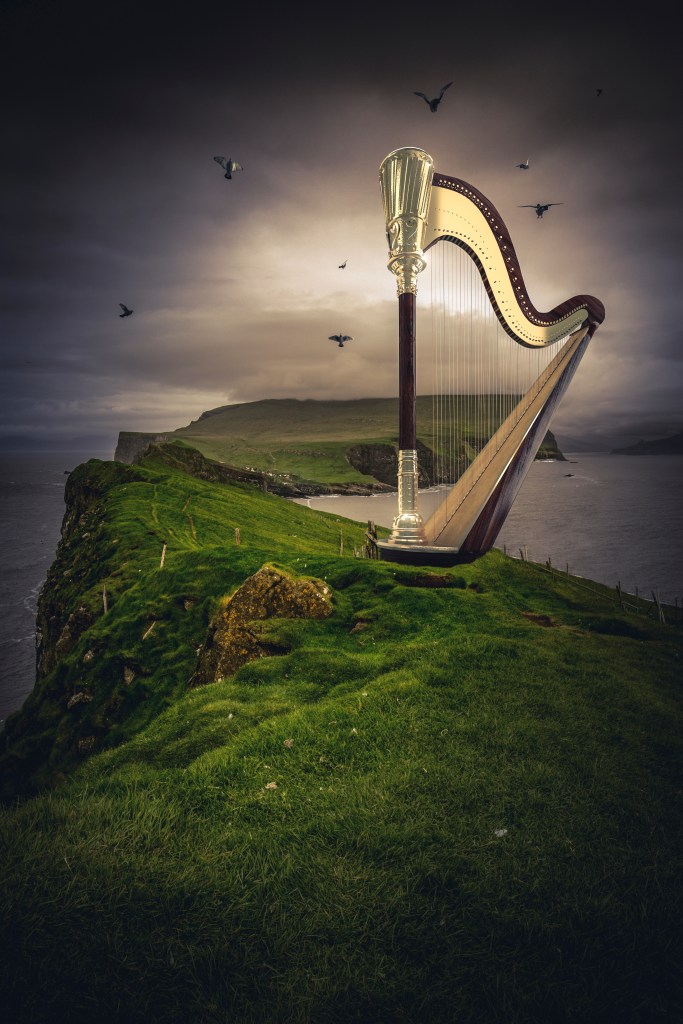
4. Celtic Harp. The harp is the national emblem of Ireland and is on the flag and currency. It also shows up on business logos, like Guinness. History on the harp does go back, at least as far as the high king, Brian Boru, one of Ireland’s most famous kings. (941-1014) He played the harp himself and encouraged music in Ireland. There is a surviving harp that belonged to him and named after him. It’s in display in the Long Room Library in Trinity College in Dublin. In folklore, the Tuath De Danann, Dagda, had a that harp changed the seasons as well as emotions of people. He used it going into battle to make his warriors forget fear. After battle he used it to help them get over wounds and sorrow of lost friends. As Celtic traditions were being replace by British influence, the harp became a symbol of Irish resistance. It was banned in 1650s. Harps and organs were destroyed and harpers were forbidden to play. Earlier, in 1603, Queen Elizabeth decreed that Irish harp players should be hung and all harps burned. That’s one way to make the harp more popular in Ireland. Listen here: https://www.youtube.com/watch?v=ZZmFhsy8QSU

5. Fiddle. Informal playing of the violin. A fiddle is great for jigs and dancing.
As early as the 1100s, the Irish were well known for its musicians. Here’s a somewhat backhanded compliment from a Norman visitor in 1185, ‘the Irish are so barbarous that they cannot be said to have any culture” However, the music: “They [the Irish] seem to be incomparably more skilled in [musical instruments] than any other people that I have seen. The movement is . . . rather quick and lively, while at the same time the melody is sweet and pleasant. It is remarkable how, in spite of the great speed of the fingers, the musical proportion is maintained.” In 1674 Richard Head said, “in every field a fiddle, and the lasses footing it till they were all of a foam.” Remember that the Irish were mostly peasants and instruments cost money. Fiddles were a different instrument than they are now. It was closer to a finger board. There are traditional players today who don’t use a chin or shoulder rests. It is thought that the fiddle was brought to Ireland by the Ulster-Scots. They in turned had gotten the fiddle from the crusaders. Some of the earlier fiddles were even made from tin, as it was easy to make and repair. Listen to this toe-tapping tune, Swallowtail jig: : https://www.youtube.com/watch?v=2ZxAVUsuE4Y
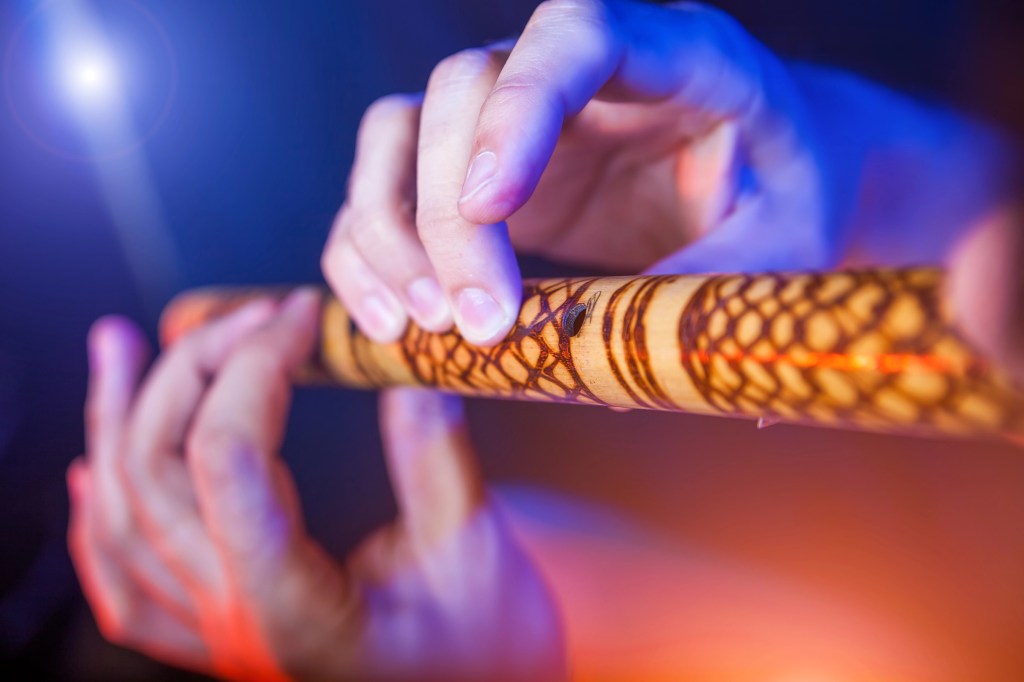
6. Irish flute. The traditional flute is simple and made of wood. The flute was first introduced to Ireland in the 1800s by the English. Though there were always, through most cultures, a form of flute, first made from bones, then wood. I imagine the Irish, like others, used some form of flute in ancient times. Theobald Boehm, a German, later introduced silver and Nichol flutes. The Irish preferred the softer tones of the wooden ones. Listen to Kirsten Allstaff play here: https://www.youtube.com/watch?v=suH5iOqOpO0
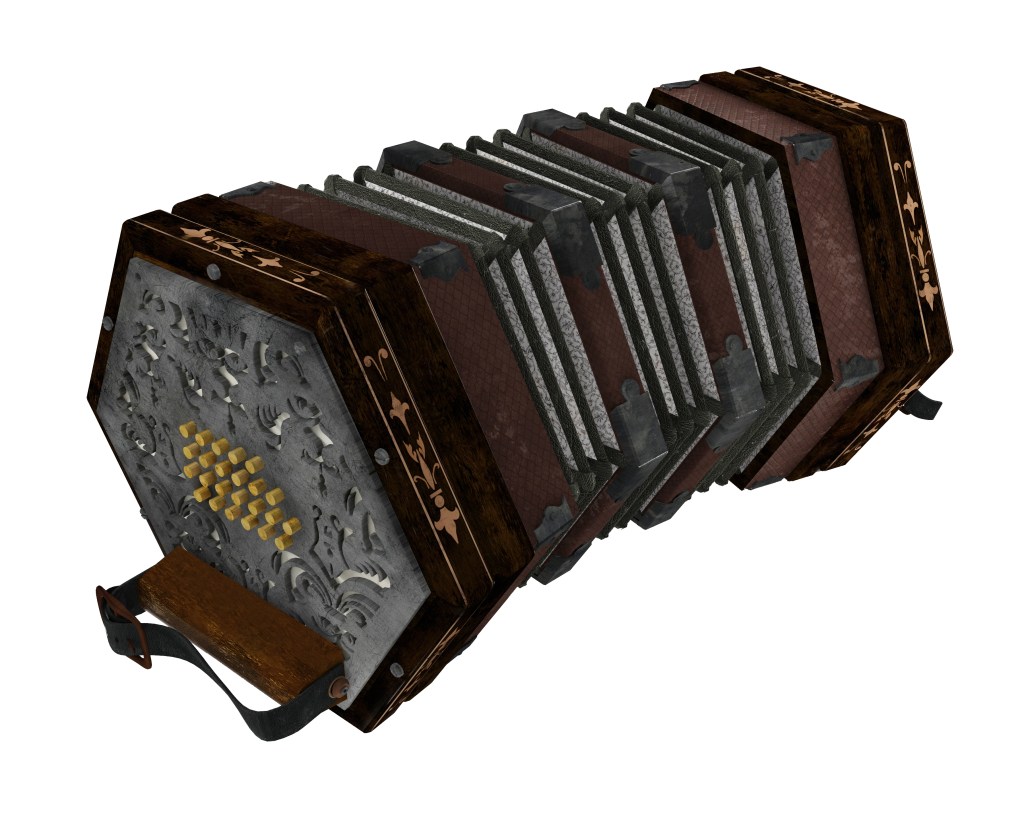
7. Concertina. Invented by Charles Wheatstone, it was a high society thing in England in 1830s. It became popular with the Irish gentry at the same time. A German, Carl Uhlig, created a cheaper version, so the lower class could afford one. It became very popular: ‘a concertina to be found in every household ready to be played by occupants or visitors to entertain the household w traditional Irish music and old tunes.’ With so many peasants playing it, it fell out of fashion with the upper class. (HA!) In the 1930s, as dances were held in parish halls instead of homes, priest opposed to the wild dancing and banned the concertina. Luckily, it’s used today in trad Irish music. https://www.youtube.com/watch?v=nOyuuAR9O-k (Spirit of Doolin)

8. Bouzouki. I know, this is not an Irish word. It’s a variation of the Greek instrument that became popular in the 1960s. In 1970 Peter Abnett made the first Irish bouzouki just for Irish players. He changed the pear-shaped body to a flat one and added straight sides. Highly popular in pub sessions. Listen to Foggy Dew: https://www.youtube.com/watch?v=yvQpNoQ6lxI
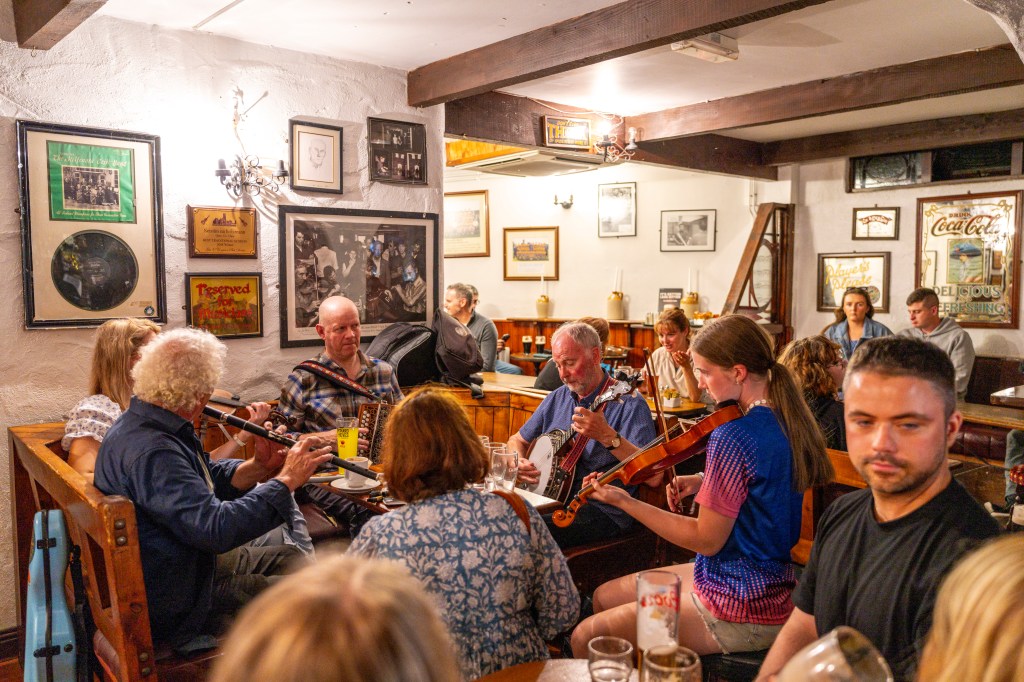
Pub Sessions – putting it all together. Pub sessions are informal, and often impromptu, gatherings of musicians playing trad Irish music. I’ve been to several Irish music events, but have never enjoyed a pub session. That’s now on my must do list. Thankfully there are Irish pubs in the USA that hold pub sessions, so if I don’t make it back to Ireland soon, I’ll look for one here. Listen to this session at the Sligo pub in PA. https://video.search.yahoo.com/search/video?fr=mcafee&p=youtube+Irish+pub+session&type=E210US1250G0#id=7&vid=8b3cc312098eedc3adb46acaf84c1f42&action=view
Do you have any favorites? Been to a pub session?
 All Things *Ancient* Irish